Concept project2026
Demo: Lärchmoser Farm Shop
A before/after demo for retail: a farm shop taking orders by email as it stood in 2012 and its new version as a shop on real WooCommerce, whose admin side is open to anyone.
Concept, design, development
Before and after
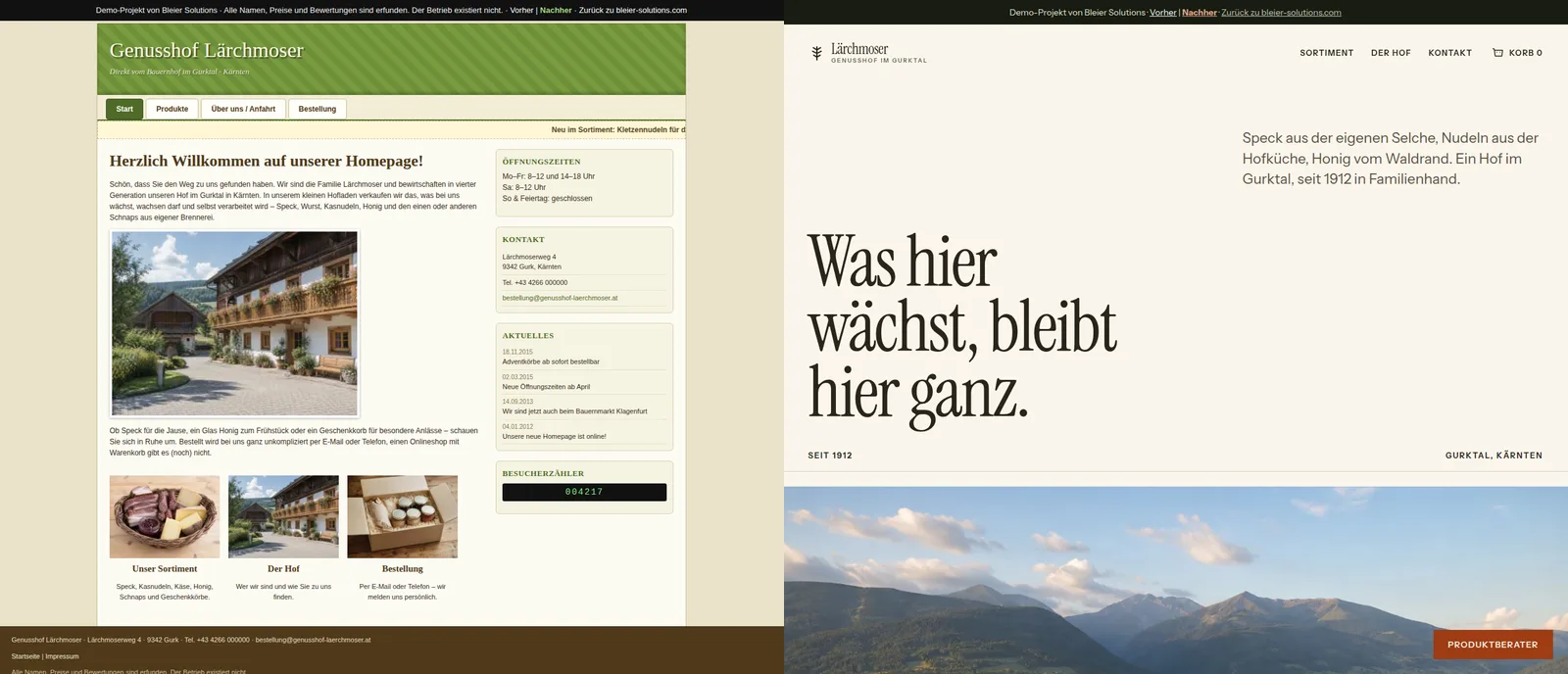
Both versions are live, side by side. A click on either frame opens it to click through.
The problem
A farm selling its own bacon, dumplings and honey sells to people who know the place, and online that ends at a website-builder page with orders by email that someone answers by hand in the evening. Anyone weighing up a shop rightly fears two things: a system nobody can maintain without a developer, and selling that nobody checks.
The solution
An invented farm shop in the Gurk valley in Carinthia, built twice. The old version reproduces a website-builder page from 2012 with a marquee, a visitor counter and orders by email. The new one is a statically served storefront in front of a real WooCommerce running in a container at home behind a Cloudflare tunnel: the range, a basket, a checkout and a product adviser on a language model. Both versions are live; a bar at the top switches between them.
Built with
Next.js · TypeScript · Tailwind CSS · Cloudflare Workers · WordPress · WooCommerce · Docker · Cloudflare Tunnel · OpenRouter · Playwright
The result
100
Lighthouse for accessibility, best practices and SEO
23
products from the WooCommerce Store API
86
automated tests
- Lighthouse on all eight core pages of the new version: accessibility, best practices and SEO 100 each, performance between 96 and 100 depending on the run; axe without a single violation.
- 23 products, 16 variants and 6 categories come from the WooCommerce Store API at build time. If the backend cannot be reached, the build carries on from a committed snapshot instead of failing.
- Orders really are created in WooCommerce: the basket goes to an endpoint of its own that checks every line against the Store API: does the item exist, is it in stock, is the price right to the cent? Nothing the browser says is taken on trust.
- The product adviser knows the range, answers with product cards you can click and puts things in the basket on request; contact details never pass through the language model. Capped at ten requests per address per ten minutes and three hundred a day.
- The shop's admin side is open: wp-admin with user demo and password laerchmoser-demo, a role limited to products and orders, and the database reset every hour.
- 86 automated tests: 35 Playwright checks on the new version including axe, 23 against the worker interface, 20 on the catalogue, shipping and adviser logic and 8 on the old version.
- Live at demo.bleier-solutions.com/hofladen/, the before version at /hofladen/alt/. The demo itself is in German.
What there is to see
All names, prices and produce are invented. The business does not exist.
What the new version does differently
The farm comes first and the range second: buying straight from a producer is a decision about where food comes from, not about a filter list. Prices, variants and stock levels are not in the source code but in WooCommerce, where someone maintains them without a developer. The basket lives in the browser, and the order is recalculated on the server before it is created. The product adviser answers questions about a platter, a gift or shipping out of the real catalogue and recommends only what exists. Nothing is paid for; the payment method is a dummy carrying a plain notice.
Working in the backend yourself
The admin side is open, and that is the real point of this demo: a shop is not the shop window but the work behind it. Change a price, add a product or process an order, and the change shows up in the storefront after the next build. The role can do products and orders and nothing else, sending mail is switched off, and every hour a cron job resets the database to its starting state. There is nothing to break that would not be whole again on the hour.
What carries over from it
The split is the proof: WooCommerce carries the range, the prices and the orders, while the storefront is static and sits at the edge of the network. The business works in an interface it knows, and customers never see a WordPress. The same division holds for any shop with a few hundred articles. A payment provider, shipping labels and the link to a till system are added in a real project; here they are invented.
Something like this for your business?
Write a few lines about what it is about. Within one working day you get an assessment with a price range and a duration.